European
Crystallographic
Meeting
|
||||||||
|
||||||||
|
|
||||||||
|
||||||||
|
||||||||
|
||||||||
|
||||||||
|
||||||||
|
||||||||
|
||||||||
|
||||||||
|
||||||||
|
||||||||
|
||||||||
|
||||||||

|
The Meeting Logo Central in the logo of ECM23 the outline of the
town hall of Leuven is shown on a blue sky. This sky is in fact
a two-dimensional diffraction pattern of a biological macromolecule,
with superimosed on it Europe's flag: a circle of golden stars,
symbol of Europe's unity and identity. The bottom of the logo refers
to the Belgian flag: three equal vertical stripes in black, yellow
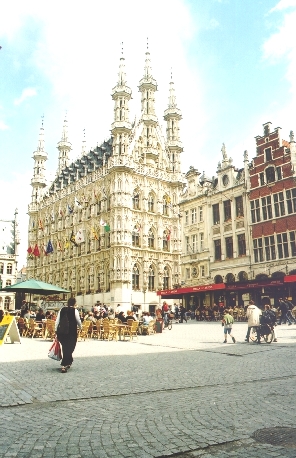
and red. More about the town hall... The magnificent town hall of Leuven in Brabantine
Gothic style can be admired at the Grote Markt (Market Square).
The harmonious dimensions and rich decoration make the town hall
a shrine of medieval splendor. The first stone was laid in 1439,
the designer was the architect Sulpitius Van der Vorst. He died
shortly afterwards and architect Keldermans continued his work.
When Keldermans died in 1445 a third architect, Mathijs de Layens,
continued the construction from 1447 until 1468. It was Mathijs
de Layens who gave the flamboyant Gothic look to the building. He
is therefore considered the creator of the town hall. In 1706 the
staircase at the entrance was added. The town hall was renovated
for the first time in the 19th century. New neo-gothic elements
and statues were added to further decorate the façade. This
was due to the French writer Victor Hugo, who, during his stay in
Leuven, insisted that statues should be made to fill out the empty
niches because he found that such a splendid building could not
be left unfinished. |