|
|
|
|
|
|
|
|
|
|
|
|
|
|
|
|
|
|
|
|
|
|
|
|
|
|
|
|
|
|
|
 |
|
ORGANIZING
SECRETARIAT
Momentum
Grensstraat 8
B-3010 Leuven - Belgium
Phone +32 16 40 45 55
Fax +32 16 40 35 51
E-mail info@momentum-pco.be |
|
|
Last
updated:
February 7th, 2007
|
|
|
|
|
|
|
| |
|
|
|
|
|
|
|
|
|
| |
|
 |
|
Short history of the city of Leuven
The city of Leuven appears in historical documents
for the first time in the year 884. In that year, the plundering
Vikings settled around an old fortification at the Dijle river,
called 'Luvanium' in Latin or 'Lovon' in the local vernacular. They
were conquered here by Arnulf of Carinthia in 891. After this victory,
Arnulf had a new castle built on an island in the river. Furthermore
he founded a chapter of canons in the already existing St. Peter's
Church. This became the home of the Earls of Leuven who later also
acquired the county of Brussels. In 1190 the Earls of Leuven came
into possession of the important title 'Dukes of Lower Lorraine',
a title that give them the right to rule over the middle part of
what is now Belgium. From then onwards Leuven became an important
administrative and commercial center, and the effective capital
of the Duchy of Brabant. A stone wall was built around the city
as well as the necessary meat, fish and bread halls. The cloth trade
became the cornerstone of Leuven's wealth and prosperity.
|
|
| |
|
 |
|
| |
|
The
14th century became the turning point
of Leuven's destiny. The cloth trade lost its importance and Brussels
aspired more and more successfully to the title of 'capital of the
Duchy of Brabant'. By this time, the Dukes of Brabant (or Dukes of
Lower Lorraine) had moved their permanent residence from Leuven to
the Coudenberg Hill in Brussels. The group of rich people that ruled
over Leuven in the 14th century had not yet understood that their
city was henceforth to play a secondary role. They continued to spend
the city's financial means as if Leuven would continue to prosper.
Between 1360 and 1383 the Guild of cloth manufacturers, led by mayor
Pieter Couthereel, continued to oppose the policy of the 'happy few',
which resulted in numerous uprisings of the population. In 1383, Duke
Wenceslas rearranged the power balance between the rich families and
the guilds. From then on, the guilds became slightly more powerful
than the traditional rich families. This situation was to remain virtually
unchanged until the French Revolution at the end of the 18th century.
Although Leuven had lost its leading role in the 15th century, the
city would witness some great events during that century. In 1425
Duke John IV founded the University of Leuven, which until today has
remained the most important university in Belgium, and one of the
leading Catholic universities in the world. A few decades after its
foundation it had already more than a thousand students. In the 16th
century some important humanists and scientists would help spread
the fame of the Leuven University over the rest of the world: Erasmus,
Mercator, Jansenius, Vesalius, and others. Also, between 1439 and
1468 one of the most splendid gothic buildings in the world was constructed
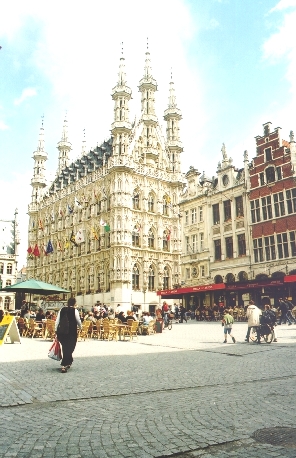
here : the town hall of Leuven (see picture on the left). |
|
| |
|
|
|
|
From the middle of the 16th century
onwards, Leuven did not escape the fate of most cities in the Low
Countries : devastating religious wars, the plague and famine resulted
in a decreasing number of inhabitants and a down-spiraling commercial
and industrial activity. Furthermore, in the period of Austrian
domination, the Austrian Emperor Joseph II, moved the university
from Leuven to Brussels and ordered many monasteries to be closed.
The monasteries which continued to exist were later plundered during
the French occupation between 1794 and 1804.
|
|
| |
|
|
|
|
Only after Belgian independence in 1830, the University of Leuven
regained again its former importance. Last century proved to be
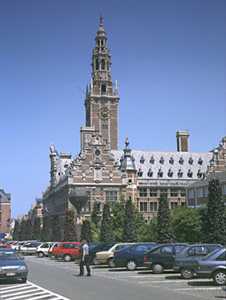
the most devastating era for the city. During the First World
War, the city centre (including the University Library) was burned,
but was meticulously rebuilt after the war. In the Second World
War, Leuven suffered again from heavy bombardments.
|
| |
|
 |
Until the 1960's, the Leuven University had been bilingual (French
and Dutch). Between 1966 and 1968 the Flemish movement demanded
a separation of the University. This resulted in frequent student
demonstrations (from both pro-Flemish student groups as well as
from pro-francophone student groups). To end this situation the
Belgian government and the University authorities decided to split
the University. The Dutch-speaking part remained in Leuven and
for the French-speaking students a new university campus was built
in the new city of Louvain-La-Neuve (= 'New Leuven', south of
Brussels).
|
Since the middle of the 1990's Leuven appears to have regained
its role as capital of Brabant, a role it lost in the Middle-Ages.
The former Belgian province of Brabant has been split into two
parts: Flemish Brabant (with Leuven as capital city), and Walloon
Brabant (with Wavre as capital).
More about Tourism
in Leuven.
More about the Places
of Interest in Leuven.
More about the history
of KULeuven.
|
|
|
|
|
|
|
|
|
|


.jpg)
.jpg)